








 Select Store
 EU
EU
 US
US

Boat Maintenance Tips
How to Extend the Life of Your Boat

Your First Big Championship Checklist
There's something truly special about a sailing championship. It's more than just a regatta; it's an opportunity to challenge yourself, explore a new venue, and become part of a community that shares your passion for sailing. Whether you’re fizzing with excitement or feeling super nervous, good preparation can make all the difference.
This guide has been put together to help you arrive prepared, confident, and ready to make the most of every moment. The better prepared you are, the more you'll be able to focus on what really matters – enjoying the experience, learning from every race, and creating memories that you'll look back on for years to come.
Give your boat a thorough MOT
We’ve pulled together this basic list below; it’s not an exhaustive list, and it’s not class specific, but it’s a fantastic place to start. You’ve been training hard all winter, so it’s time to get your boat back on point for its Championship showcase.
If you discover an issue and aren't sure how to fix it, don't panic. Your Class Association community is often the best place to start. Class sailors and coaches have a wealth of experience and can usually offer practical advice or point you towards the manufacturer or class-approved hacks.
The Team at Rooster are always on hand to help, and true to our heritage, the team love nothing more than bimbling with boats and looking for those small wins to allow you to be in your element. Whether you need advice on maintenance, replacement parts, or essential spares, get in touch; we'd be delighted to help you arrive at the championship feeling ready to perform at your best!
Category
Subcategory
Check Item
Hull
Structure
Give the hull a good once-over and look out for any cracks.
Hull
Structure
Check the mast step for cracks or anything that doesn't look quite right.
Hull
Structure
Look for scratches, cracks or peeling grip around the centreboard case.
Hull
Finish
Tidy up any chips and scratches before they get worse.
Hull
Finish
Make sure the self bailer opens and closes smoothly and isn't full of grit.
Hull
Finish
Check your bung is in good condition and throw a spare in the toolbox.
Spars
Mast
Sight up the mast and make sure it's nice and straight.
Spars
Mast
Check fittings and rivets for corrosion, movement or wear.
Spars
Mast
Make sure all mast sections fit together snugly.
Spars
Boom
Check fittings and rivets are secure and corrosion-free.
Sail
Panels
Hold the sail up to the light and look for holes, tears or thin patches.
Sail
Stitching
Check seams are intact and not starting to pull apart.
Sail
Battens
Make sure battens are undamaged and seated properly.
Rigging
Halyard(s)
Look for worn spots, fraying or damaged rope.
Rigging
Mainsheet
Check for wear and any sections that feel tired.
Rigging
Jib Sheet
Make sure it's running smoothly and isn't showing signs of wear.
Rigging
Spinnaker Sheet
Make sure it's running smoothly and isn't showing signs of wear.
Rigging
Controls
Check the kicker is working smoothly and still bites.
Rigging
Controls
Make sure the outhaul runs freely and holds tension.
Rigging
Controls
Check the downhaul isn't worn and can be adjusted easily.
Rigging
Controls
Make sure the traveller isn’t wearing through.
Rigging
Painter
Check for wear and confirm it complies with class rules.
Rigging
Clew Strap
If the velcro is slipping, it's time for a replacement.
Rigging
Blocks
Spin every block and make sure ratchets still sound and feel healthy.
Centreboard
Foil
Check the leading edge for chips, dings or rough spots.
Centreboard
Foil
Make sure the trailing edge is smooth and undamaged.
Centreboard
Case
The board should go up and down smoothly without sticking.
Centreboard
Elastic
Make sure the elastic still has enough life to do its job.
Rudder
Blade
Check for damage, chips or rough areas.
Rudder
Stock
Make sure all fittings are secure and in good condition.
Rudder
Tiller
Look for cracks or sun damage in the universal joint – they often fail without warning.
Toe Straps
Webbing
Check for wear where straps rub and inspect all fixings.
Toe Straps
Elastic
Make sure the straps still spring back into position.
Fasteners
Hardware
Check screws are tight and haven't worked loose.
Fasteners
Hardware
Check bolts are secure and corrosion-free.
Fasteners
Hardware
Fresh tape always looks smarter and makes spotting problems easier.
Buoyancy
Hatches
Check seals are clean and keeping water where it belongs.
Buoyancy
Buoyancy Bags
Inflate them and make sure they're holding air properly.
Buoyancy
Leak Test
A bubble test can uncover leaks before they become a headache.
Trolley
Frame
Look for rust, corrosion or signs of fatigue.
Trolley
Wheels
Check tyres are inflated and ready for a long walk to the slipway.
Trailer
Bearings
Give them a check now rather than on the hard shoulder later.
Trailer
Lights
Test everything before setting off.
Trailer
Straps
Make sure straps are in good condition and still doing their job.
Measurement
Class Rules
Double-check sail numbers are correct and clearly visible.
Measurement
Class Rules
Make sure all required equipment is onboard and class legal.
Get the right gear
The right kit really makes all the difference on the water, and the beauty of British weather means you can launch in a sublime summer's day and be chewing through a hail storm as the four minute gun goes for the start of race three. Staying warm, protected, and comfortable means you can focus on performance — and staying out for longer.
We’ve tried to take all the faff out of packing your kit bag and created these handy what to wear guides, from Juniors through to trapezing, there’s something for everyone
Pack the opposite kit in your dry bag in your boat; if you’ve launched in glorious sunshine, make sure you’ve got a lightweight spray top and beanie you can pop on if that sea breeze kicks in or you have an accidental capsize. On the flip side, if you launch in a cosy Aquafleece, make sure you can pull it off in between races, if that sunshine does show its face. Top it off with a cap, with an epic pair of sunglasses and a slathering of suncream.
It can be really tempting to pop all your spares in a support rib, but it’s not always possible to find them in between races, even with the most attentive crew. So, keep those essential bits of kit and fuel close in a little dry bag in your boat, so you’re not caught short! Hangry and freezing is not the way to spend a day.
Don’t forget on shore too; changing rooms at big championships can be manic. Write your name on every single bit of kit you own and consider al fresco changing alternatives, like a quick dry poncho and a changing mat if you’re not a fan of the crowds.
Spares
After you’ve read this blog, your boat will be MOT’d and bimbled to perfection before your regatta, but breakages do happen, even to the most prepared sailors. Either tucked in your buoyancy aid, or safely stowed in your boat, we’d suggest always having these two secret weapons.
Small Carbine Hook – Shackle gone? Bosh clip it back on.
Rope that is 1.5 metres long, around 3/4mm - tie something back together, it won’t be pretty, but it will get you round.
Breakages are great challenges to overcome, but it’s good to practice them in a low stress environment. What would you do if your mast webbing strap failed on your topper? Or if your kicker clip blew up on your RS Tera? Have a go on shore, and then on the water, testing how you could bodge a fix, it could save you a big point discard or even better, you could help a friend on the water.
Fuel
Eating and drinking the right things before, during and after racing will help you stay focused, make better decisions, and maintain your energy throughout the duration of the regatta.
Before heading afloat, aim to eat a balanced meal containing slow-release carbohydrates such as porridge, wholegrain toast, cereal, or pasta. These foods provide a steady source of energy that will last longer than sugary snacks.
Hydration is equally important and an easy to sip on the go bottle is essential. Start drinking water as soon as you wake up and continue throughout your morning preparations at your accommodation and in the boat park. Even on cooler days, it's easy to become dehydrated without realising it, which can affect concentration and performance. A very simple rule of thumb is that you should be drinking approximately 1 litre for every race you do. This isn’t foolproof, so please adapt it for your needs and the conditions on the day.
For longer days, pack simple snacks that are easy to eat between races. Bananas, flapjacks, cereal bars, dried fruit, wraps or a sandwich are all great choices. These provide quick energy without causing a sugar crash. Try to avoid relying completely on sweets, chocolate and energy drinks. While they may give a short burst of energy, they can leave you feeling tired later in the day. With everything in life, there’s a balance to be found, make sure you’re excited to tuck into something tasty between races.
Remember: good sailors look after their boats, but great sailors also look after themselves. Fuel your body well, and you'll give yourself the best chance of performing at your best on the water.
Relish the detail by doing your homework
One of the easiest ways to gain confidence before your first championship is to arrive as prepared as possible. Long before you launch your boat, there is a huge amount of information available online that can help you understand the event and venue. Start by reading the Notice of Race and Sailing Instructions so you know the format, schedule, and key rules. Watch any competitor briefings if they are available and take note of local advice.
Explore the venue on Google Maps to familiarise yourself with launching areas, race courses, parking, and facilities. Check out the club and class websites to learn more about the venue, local conditions, and previous events. You can even use Google or ChatGPT to research typical weather patterns, tides, currents, and sailing tips for the area. Did you know we have some of our own venue guides by the legendary Steve Cockerill and our fantastic Rooster Riders? If you’re heading to Weymouth, Largs or Pwllheli this summer, you’re in luck! The more you know before you arrive, the less there is to think about when racing starts.
Good preparation won't guarantee results, but it will help you feel confident, organised, and ready to make the most of your championship experience.
Set goals that you can control
Attending your first championship is exciting, but it's important to remember that success isn't just about where you finish. Rather than focusing on winning, set yourself SMART goals; goals that are Specific, Measurable, Achievable, Relevant, and Time-bound. For example, you might aim to get a front row start in at least three races, change your settings on every leg of the course, or not to be the outside boat at every mark rounding.
These are things that are within your control and can be measured throughout the event. By focusing on personal performance goals rather than results, you'll gain confidence, learn more from the experience, and finish the championship with a real sense of achievement, regardless of your overall placing.
And finally
Above all, have fun. Throw yourself into the experience, make some new sailing mates, and try to enjoy every minute both on and off the water. There will be plenty to learn, plenty to laugh about, and hopefully a few adventures along the way. Sail your best, embrace the challenge, and make some awesome memories you'll be talking about for years to come.

Steve's Start of Season Checklist
Here is my checklist for when the season starts and I lift the cover off the boat - usually too late!
Toestraps
I check my toestraps for signs of wear, the toestrap fixings and rope attachments.
Spars
Look over your rivets and fittings for any signs of wear. If there are any wobbly fittings then it's time to change the rivet. You might also like to check the related blog on helpful hints on Riveting. Don't forget to use some Duralac to help stop the corrosion that occurs between dissimilar metals and please use a 4.8mm drill bit not a 5mm drill bit. We stock a wide range of Holt, Allen, Ronstan, Superspars and Selden spars and fittings. Check your shrouds and halyards for signs of wear and make sure your halyard tails are remade so you don't loose your jib halyard on your first hoist. If you have a rope halyard - I can't recommend Halitec enough if you want a non stretch, durable 4mm easy cleat halyard. If you use a 2:1 halyard, you might like to check that the termination at the top of the mast is smooth with no sharp edges and move your knot ready for the season. We tend to supply Halitec main halyards that are very generous, so you can move the wear position throughout the season - just to be sure.
Sails
Simple tears in the body of your sails can be repaired with sail or spinnaker repair tape, but for bolt rope issues and tears in your loaded areas, you will need to take it to your local sailmaker.
Rope
You might like to wash your ropes to rejuvenate them, but if you are using Polilite® sheets, remember that the outer braid is the load bearer, so changing them annually on high wear sheets is recommended. If your sheets are not running well, you should ensure that the blocks that they run through are at least 4 times the diameter of the rope. Check over your primary load lines. You might like to get some top tips on how to do some splicing - check out our how to video tips on this. Control lines that have gone flat and are showing signs of wear can either be end for ended to improve their longevity, or changed. If you are keen to do some continuous control lines, we have the video so you know the secrets.
Blocks
If they are not working too well, they might just need some soapy water and some lubrication to get them working as good as new, but if they are looking dodgy and need changing, we can help.
Cleats
Even after some lubrication you might have some issues with your cleat holding lines. They might be over tightened or the return spring may need adjusting. If your jaws are worn flat, a needle file can put the bite back into them, or you might just need to replace them.
Trailers
An annual check and service is advisable and we have entire blog post dedicated to the job.
Hull
Check over the outside for any nicks that can be easily repaired with your gelcoat/catalyst mix. You should be able to get your colour from the boat manufacturer. The best polishing compound to bring up the finish after you have used wet and dry paper is Farcela, followed by an environmentally friendly hull polish.
Foils
The finish on these is much more important than the hull. Check out our blog on an epoxy foil repair. When you have finished your A1 job, don't forget to wrap them up in a decent Foil Bag when travelling.
Rudder Stock and Tiller
Your tiller extension joint is likely to be perished - I think we stock every type at Rooster! I tend not to use the rope cored versions as I don't have faith in them. Once they have see through rubber, my feeling is that the UV degrades the rubber quicker. I recently changed my RWO black standard joint on my tiller extension that I put on before the 1995 Olympic trials - it was starting to look perished! If you are confused about how to attach your joint to your tiller, our video should help. Rooster Carbon Tiller extensions make changing the joint a 3 minute job and are a bullet proof option - but we also stock aluminium ones as well if you prefer. Your rudder stock is a vital piece of equipment. I tend to check it for corrosion or cracking. We stock a wide range of rudder accessories from wing nuts, gudgeons and pintles for both the boat and your stock.
Feel free to comment below with your boat prep successes and failures!
Happy Preparation, Steve
Save
Mark's Guide: 7 Essential Tips and Checks for Winter Dinghy Maintenance
Extract from book, to be the published "Maintenance and Recommissioning of Racing Dinghies”
1. Storage
Wooden Boats. There is only one place for an all wood or composite racing dinghy to be stored, and that is undercover in a dry storage garage, workshop or shed. Even with modern varnishes (1 and 2 pot) and epoxy coatings, there is still a chance for water, ice & frost to penetrate the surface & joints and damage the wood. Expensive to repair once damaged, and water damage often ends up being painted over due to discolouration.
Plastic boats. All glass and FRP boats will survive the UK winter climate outside but invest in a good breathable cover with a deep skirt as seen in the photo 1 - on a Solo dinghy. It will also prevent UV fading of the gelcoat as seen on this blue 2000 - See photo 2 below.
Photo 1
Photo 2 - Shows typical UV fading if left unprotected, the gelcoat is slowly degraded by UV radiation causing the surface to become yellowy / white and powdery as the gelcoat is oxidized. – Can be expensive to correct.
Also, I have seen ILCA/Lasers hulls that have been dry stored (and with non-breathable PVC covers - both with top and undercovers) being stored inside with damp or wet surfaces and can suffer over time from osmosis.
Make sure the carpet or protection used on the trolley cradle is dry before storing, as this will hold water and damage the hull (both wood and plastic hulls) surface over time.
2. Sail Care
Remove the sails from your boat. Boats both stored outside and inside are a target for rodents to hibernate in and eat your sails and sail bags. The damage can be extensive.
Give them a thorough rinse with fresh water from a hose. I hang mine up to dry on the washing line (use the mainsheet rope) and then store indoors/garage/workshop. Check for any damage around the batten pockets and headboard/luff rope area and get any repairs at your local sailmaker.
3. Spars
Remove the spars from your boat, wash, dry down and then dry store if possible. Galvanic corrosion (see below photo 3 example of a RS400 s/s block mounted on the boom) can occur between the stainless-steel fittings and your aluminium mast. Note: Carbon fibre masts will not suffer from galvanic corrosion but metals in electric contact (and the presence of an electrolyte such as salt water) with carbon can cause issues.
Photo 3 - Above (red arrow) shows typical galvanic corrosion that occur between the stainless-steel fittings and your aluminium spar.
If you find an issue, then remove the stainless fitting, and clean the area behind them thoroughly. Bed the fittings down with Duralac paste applied to the entire surface when putting them back, taking care that there are no voids between fitting and mast wall where water can get in and stand. Duralac also provides corrosion protection. Also, add a smear Durlac on the screws or rivets when affixing the fitting.
Duralac paste (photo 4) is a chromate containing jointing compound designed to inhibit electrolytic decomposition between dissimilar metals – often called galvanic corrosion. It is a single pack, air setting product. Used correctly, Duralac prevents anodic decomposition.
Photo 4
4. Hull Upkeep
Wash and polish the hull. Many sailing areas around the coast suffer from the issue of sewage discharge into the sea and harbours. This is especially noticeable on the light breeze days, when a light brown scum line can be seen on the waterline of your dinghy.
Wash down every time you exit the water and sponge off the hull. The discharge is stubborn to remove and will stain especially FRP/Glass boats as seen in photo 5 and can be difficult to remove without a good deal elbow grease and a product like the Facecla G3 Fine Finishing Compound to remove the staining. Finish off with a good quality polish such as the McLube polish.
Photo 5 – Pollution staining
5. Ropes and control lines
Remove and wash the control lines and sheets (remove all non-continuous control lines). You can put the control lines in a bucket of warm water with a mild detergent to soak. The mainsheet, jib and kite sheets in a pillowcase, tie off the opening and put in a washing machine on a cool temperature wash with a suitable conditioner. When the cycle is complete remove from the machine and allow to dry off before storage.
6. Security
If the boat is stored - especially in the winter months in the local dinghy compound or park, make sure that the boat is tied down well, the cover is undamaged and that the securing clips are locked in place and tightened. It is important to check that your insurance covers you for winter outdoor storage. Make you own ground concrete tie down anchorage fixings if needed. (Photo 6)
Photo 6 - Build your own concrete tie downs - if permissible by your club.
Use wheel clamps & hitch locks, plus padlocks and chain (photo 7) for added security.
Photo 7 - A substantial wheel clamp and padlock.
7. Maintenance
Deck fittings
I recommend slightly loosening off the tops off your cam cleats and giving them a thorough clean with mild detergent and fresh water. When dry, apply a dab of Harken McLube OneDrop Ball Bearing Conditioner. Do not use grease or oil as this will attract salt particles next season. Damaged cam springs can be replaced, and you may need new cams cleats if you have signs of wear on the cam teeth. Ball bearing mainsheet block systems and traveller cars need particular attention, flush through with fresh water. It’s a good time to check traveller cars are running freely and replace if necessary. Check all rudder fittings both for galvanic corrosion between the alloy fitting and the screws/bolts. Check for tightness of all fixings.
Toestraps
One the most used items on the boat and take considerable amount of stress and strain during the season. They generally start to wear at the edges, around the pressed in eyelets and the mounting points (if they are screwed down via the gripper plates) check the fixing points and tighten any screws and replace any adjustment ropes as necessary toestraps should be given a good clean and thoroughly washed with freshwater. Toestraps are easily replaced and are relatively inexpensive and can smarted up an otherwise tatty hull. Check your gripper plate screws for tightness as seen in photo 8.
Photo 8 - A typical toestrap gripper plate.
Foils.
Rudder and daggerboards/centreboards are easy to work on indoors. Check the leading and trailing edges for signs of damage before storing away. Any gelcoat work should be done at this time in a warm (indoor) environment.
Bailers leaking?
Now is the time to replace those internal rubber seals with a service kit. Otherwise, if not leaking, then just putting the bailer down and then smearing a small amount of Vaseline along the sides and back of the wedge that protrudes below the boat to keep it in good shape. Then put the bailer up and wipe off any excess.
Trailers and Trolleys.
Trailers: Grease the bearings (or replace the entire hub if corroded (photo 9) or you have worn bearings - and they become noisy or stiff when rotated). Locate the grease fitting—it is the nipple (photo 10 - see the red arrow) that fits into the female end of a grease gun. Squeeze grease from the gun until bearings are well lubricated (but not too full).
Photo 9 - A trailer wheel & hub in poor condition.
Photo 10 - Location of the hub grease nipple.
'Milky grease' in the bearing is a sign that it has been compromised by water. If this happens, repack all bearings or replace. Lubricate your wheel nuts. Doing so will help you to loosen them when changing wheels. This is especially important if you are fixing a flat by the side of the road. Wheel nuts tend to rust easily. Use Copper Ease grease to lubricate the threads to stop them seizing. Check your tyre pressures. Check the tyre sidewall (also for sidewall perishing) for the correct pressure and ensure the tread depth is not below the legal limit. 1.6mm is the legal minimum tyre tread depth for all vehicle tyres, including trailers, a minimum of 3mm is recommended, as this ensures the safest driving - and towing - experience across all road and weather conditions. Below this level, handling can be compromised.
Trolleys
Check you glass fibre cradle(s) for cracks or damaged, and repair. Replace the any damaged foam covering or use the Astro Turf matting – (See photo 11). Get any metal/welding repairs done now rather than in the middle of the sailing season. Repairs will almost always be cheaper than the cost of a new trolley. Consider replacing your pneumatic wheels with puncture proof wheels/tyres if your boat is launched from a hard surface. (Not recommended for sandy foreshores).
Photo 11 - Astro Turf matting.
Astro Turf matting (photo 11) as used on the trolley cradle. Reduces water retention and possible scratching of the hull from any grit and sand held on the cradle. Consider a set of puncture proof wheels as seen in photo 12 - ideal for launching from hard surfaces.
Photo 12 – A puncture proof trolley wheel
Photo 13 - A wide 'beach wheel' used on for launching on sandy and soft launching areas.
If you leave you boat outside, use a decent prop, so if any water that does get in - it can drain out. -Photo 14
Photo 14 - Use a prop to support your dinghy.
Final bit of advice!
Investing time now to prepare your dinghy for winter will pay dividends when the warmer weather comes around, enabling you to get sailing quickly again without any fuss. You will also have helped to protect your investment for the longer term.

RS Aero Foil Repair - A step by step guide
A few weeks ago, I was presented with an RS Aero dagger board and rudder blade that had multiple damaged areas to both the leading and trailing edges. The main surfaces of the foils had no damage, it was just the edges that needed some repair work.
Below are some images of the damaged RS foils. The damage may look bad, but with a few simple tools, a good warm day (or a heated workshop) any DIY'er can make a good repair, and get a fair finish with patience, and plenty of 'elbow grease'.
Thanks to John Purdy of DQSC for the video work and images.
Tools and materials that are needed to complete the work:
Tools:
1. A 'Dremel' or hand file.
A typical low cost battery 'Dremel style' hand grinder.
2. Latex gloves and a suitable dust mask.
3. Lint free cloth.
4. Optional - a hot air gun.
Materials:
1. Acetone solvent.
Acetone - 500ml – ROOSTER UK (roostersailing.com)
2. Assorted wet and dry papers + a 120 grit paper (used dry), and suitable small sanding block for the 'wet' sanding.
3. FARECLA G3 Rubbing Compound Regular cutting paste.
Farecla G3 Finishing Liquid Paste Compound - 400g – ROOSTER UK (roostersailing.com)
4. FARECLA G10 Finishing Compound.
5. Basic white gelcoat and the catalyst.
Basic Gelcoat 75ml Tin (Clear and White) – ROOSTER UK (roostersailing.com)
Polyester Catalyst for all polyester resins and gelcoat - 50ml – ROOSTER UK (roostersailing.com)
6. Quality masking tape.
7. Mixing cups and wood (or plastic - they are reusable, as they can be cleaned up with the Acetone solvent) mixing sticks.
West System 804 Reusable Plastic Mixing Stick – ROOSTER UK (roostersailing.com)
Mixing Stick - Large – ROOSTER UK (roostersailing.com)
8. A large sanding block for the 120 grit oxide paper.
Work Flow:
1. First clean down the complete foil (the dagger board in this case) with acetone solvent using a clean cloth to remove any containments, grease etc. Please wear gloves when handling acetone. If you get acetone on the skin it may cause skin irritation; skin may be dry, red and inflamed. Eye contact with liquid and acetone vapours can lead to irritation or eye damage.
2. Using a small hand held 'Dremel' or metal file clean out the damage area and work the edge of the damage area to create a bevel or 'v' shaped edge to the repair area. See the below video. The Dremel used below had a small 60 grit disc fitting to remove the damage areas and make clean. Please wear a suitable dust mask.
3. Using the Acetone solvent clean the damage areas to remove the dust and containments etc as seen below image:
4. Mix the white gelcoat well to ensure the wax additive, the pigment and resin are all well mixed together.
Adding the Catalyst:
Catalyst 2% is ideal, 3% is a fast mix. Additions outside these bands in not advisable for proper curing, in fact adding more than 4% may result in a failure to cure. The pot life of these mixes is also determined by temperature. The higher the temperature the faster the cure. Ideal temperature is 16 - 20°C
Use 6 drops into approx. 10ml of resin. (As a guide 1 UK tablespoon = 14.2ml)Curing: At 15C pot life is approx 15 mins, repair cure 1-3 hours. At higher temps, cure times will be reduced and colder, will be slower. Never work on surfaces colder that 5C and do not allow the resin or catalyst to freeze.
The above video was taken when the air temp was approx. 20deg C - ideal for gelcoat repairs.
5. Mix the gelcoat and catalyst together for at least 1-2 mins and if a little cold, use a hot air gun on a low setting to decrease the cure/setting time of the gelcoat mixture as seen in the video.
6. Apply the gelcoat mixture to the damage areas, using a 'stippling' technique (either with a small stick or small brush) to apply the mixture, so to try and prevent small air pockets forming. See below video:
7. You can, once the gelcoat is applied, cover the repaired area with Sellotape (or similar) to even out the finish of the gelcoat surface and helps reduce wet standing of the repair when cured. See the video below:
20 mins later....
8. One the first layer or coat of gelcoat on the repair has gone off, you can repeat the process again to add another coat to the repair area(s) if the area is a little low in surface height.
9. Once the final coat (2nd coat in this case) of gelcoat has cured (overnight in this case) this is how the foils look before final shaping and fairing.
10. Using a 120 grit oxide glass paper (dry) very lightly rub down the excess gelcoat, with a block, taking off just the excess/high gelcoat.
Final wet and dry of the repaired gelcoat surfaces:
11. Now, using a quality masking tape, mask up around the repaired areas as shown in the below video. The idea is that the tape will help protect the existing gelcoat surface and try to prevent you accidentally rubbing through the very thin original white gelcoat surface of the foil.
12. The final wet and dry fairing can now start. Start with a 320 grade wet and dry paper.
13. Use the 320 grit then a 400 grit paper, with a little drop of detergent in the water. This will prevent the paper from clogging up. After that, wash down with clean water and dry it off. Then use the 600 grit, followed by the 800 grit grade - you can go to 1200 grit to remove the final fine scratches from the surface. Suggest use genuine 3M paper, it is the best - Wet and Dry Waterproof paper - it does last a long time compared to low cost papers.
After the 1200 grit, go and use the FARECLA G3 Rubbing Compound on a damp clean cloth to apply, to remove any small imperfections.
14. Final polish - Use FARECLA G10 Finishing Compound again on a damp cloth.
The finished results:
RS Aero Dagger Board
RS Aero Rudder Blade
Addendum
Question from a RS Aero owner via FB:
Any ideas on how to fix the trailing edge on the black bit. photo below: the delaminated area is only about 10 mm long.
Answer: I would suggest a little pre thicken epoxy adhesive, such as the WEST G/Flex https://www.roostersailing.com/products/146160 mixed with small amount of Black Epoxy Pigment.
Lift up the delaminated area, clean and then apply your mix. Then clamp and leave to cure for overnight etc. Careful wet sand down and polish etc.

The Laser/ILCA Daggerboard Board - Major repairs
As we close in on the start of the new spring/summer sailing season, one question that comes up is how to carry out DIY repairs on foils such as the Laser dagger board.
So from the 'Rooster archives' is a short video on how to repair major trailing edge damage - Check out the below video. The paint used is a quick drying (and a very similar colour match to the existing satin white finish) is the Plastikote Multi-surface Spray Paint product available from all good hardware stores....
For really strong repairs (in lieu of conventional laminating resin) the WEST G/flex product is recommended....
Rooster Carbon Tiller Extension Repair - Accidents do happen...
The Rooster Carbon Tiller Extension is a valuable assent to the dinghy sailor, being strong, light, robust - and they do not corrode.. They have been in production with Rooster for over 20 years, and the design has evolved to make it a market leader in its field, and used by some of the legends of sailing around the world...
The current product comes in a number of lengths and 3 diameters, and is pre-fitted with a universal joint and a smart rubber Rooster end stopper.. (Rooster Rubber stopper spares are available if you loose or damage one).
The tiller extension UJ has a simple fitting arrangement to the main tiller tube and UJ's can be changed in minutes in the event of a UJ failure. Cutting the Rooster tiller extension to a custom length is also a simple DIY task. An optional sleeve rubber grip can also be easily retro fitted.
Now, I will be first one to admit it, at some time in may dinghy racing career, I have broken the odd carbon tiller, either by refusing to let go of the tiller in a capsize, sitting/falling on the tiller extension, or getting it jammed in the cockpit, rigging, or the odd control line, or even in the odd crash tack or gybe, boats capsizing on the beach, the list is endless.. accidents do happen, and the most common form of failure is due to high impact and load... Carbon tube is not indestructible ....
Typical Carbon tube breakage due to high impact & load
So, can a Rooster carbon tiller be repaired using a few simple tools and have adequate strength again?
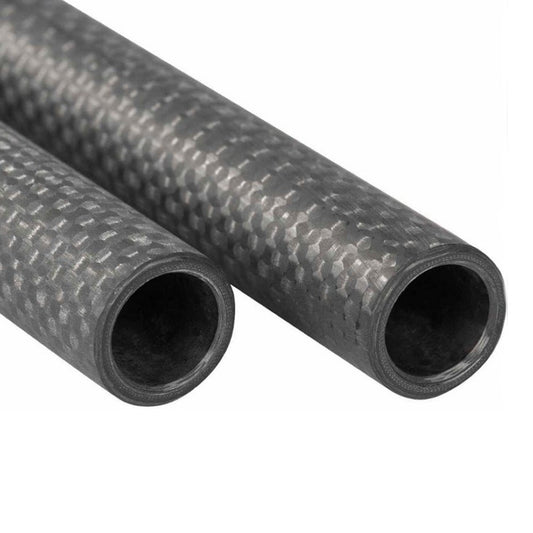
Yes...Rooster can offer 3 repair sleeves that are matched fit to go inside your existing carbon tube.
A carbon repair inner tube sleeve* for a 19mm dia. Rooster tiller extension.
A carbon repair inner tube sleeve* for a 22mm dia. Rooster tiller extension.
A carbon repair inner tube sleeve* for a 25mm dia. Rooster tiller extension.
(* Available from Rooster from March 2023).
The inner sleeve is a tight fit to give structural strength and long enough to spread any potential loads on the repaired area.
Below, the new carbon fibre repair tube for a 22mm O/D Rooster Tiller:
Tools required:
A sharp hacksaw blade and hand saw.
A flat & round metal file.
Masking tape & some plastic wrap.
A hot air heat gun (cold weather only).
A 2 Part epoxy glue - such as West G/flex Thickened Epoxy Adhesive or a 10min Rapid adhesive
Optional pigment (Black) - only a very small amount is required.
Acetone solvent.
Disposable latex gloves. (Note: you get a pair with the West G/Flex kit product)
180 grit Aluminium Oxide paper.
Process:
First wrap masking tape around the carbon tube close to the damage area to create straight cut guide line.
Cut the damaged sections with your sharp hacksaw and check you have two straight 90 degree cuts.
Now rub down (or use a round metal file) with the 180 grit paper the inside of the carbon tiller extension tube to remove any possible release agent that used in the manufacturing process. Clean down with the acetone solvent to degrease etc both the inside and outer tube areas.
Now rub down with the 180 grit paper the outside of the carbon tiller short sleeve to a matt finish, and again degrease with the Acetone.
Now, test fit the new repair sleeve in the tiller. It should be a snug fit.
Prepare the adhesive as required, typical a two part epoxy glue, either a rapid or slow cure (G/flex Thickened Epoxy Adhesive). Mix well. Now warm the carbon tube surfaces with the hot air gun (on a low setting) to aid curing. You can also warm the adhesive to speed up curing times in cold temperature environments.
If you wish, you can add (and mix well) a very small amount of black pigment to the mix. Now apply the mixed adhesive to the sleeve and inner tiller tube surfaces and fit the new sleeve to both ends of the tiller tube (50/50 sleeve in each tiller tube end).
Push fit the repair together and if you wish, apply a small amount of plastic film to smooth over the repair as seen below. Allow to cure. Remove the film when cured.
Rooster has a easily applied rubber grip tubing that can be fitted to the carbon tube to give extra grip etc. Remove the UJ (one screw) and slip on the rubber heat shrink material. Use the heat gum to shrink the rubber grip to the tiller as required.
The finished repair...
How to fit a typical dinghy sheave box into a spar
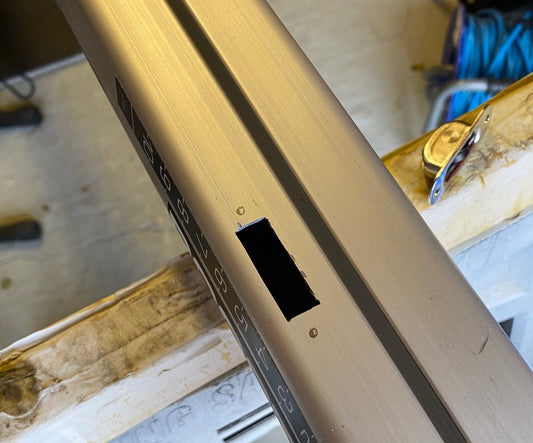
This a short article on how to cut a neat slot in your alloy mast or boom to fit a typical sheave box. This example is fitting a small 15mm diameter sheave block (from Ronstan) into a boom for the adjustment of the outboard end of a mainsail flattener.
Tools required:
Pencil.
Masking tape.
Ruler.
Vernier Callipers. (Optional)
Hand/Electric drill and bits.
A center punch.
A small metal file. (Flat or triangular).
A 'Dremel' tool and cutting disc attachment. (Optional)
Self tapping screws or pop rivets to fix the sheave box.
Duralac Anti Corrosive Compound.
A typical Sheave box e.g a..- RONSTAN RF15711.
or the Spinnaker 4mm sheave box from Super Spar PN 409
Procedure
First make sure you choose the correct fitting for the job, based on the control rope size, and expected load that will be used on the fitting - and the position of the fitting in the spar. As you will be cutting a slot in the spar, you need to keep the slot/hole to a minimum and locate the new fitting away from areas of possible high stress areas such as spreader brackets, gooseneck areas, kicker and mainsheet take off points for booms and the like. For a typical dinghy mast the front of the mast is normally one the strongest sections of the mast, especially in the alloy tapered section, where it will be welded, as this area will be thicker. For booms, the top and bottoms of the section are the strongest areas.
Measure carefully the cut-out dimension for the sheave box. Manufactures dimensions can be used - but have been known to the incorrect, so use a pair of Vernier callipers to measure the actual fitting. You could even make a small cardboard template first to test fit your new sheave box. In this case the dimensions are 28 x 9.5mm for the RONSTAN RF15711 sheave box.
Using masking tape affix this to the area where you wish to cut the slot, and mark with a pencil and with a small Engineering ruler and square, mark out the area to be cut out. Measure and recheck before any drilling or cutting….
Using a 4mm drill bit (depends of the fitting slot cut out size width), now carefully drill 4no.holes inside the measured-out rectangle. Use the metal centre punch to tap a light mark, so the drill bit does not wander when you start to drill the 4mm holes.
Now, if you have a Dremel tool you can cut down the sides to join up the 4 holes to remove the bulk of the metal. If you do not have this tool, then simply drill more holes down each side and then file down to create a neat rectangle slot.
Remove the masking tape, and now test fit the sheave fitting and mark the position for the affixing holes.
Now drill the holes for the screws or rivets. For self tapping screws you will need to drill the correct size hole by selecting the correct drill bit size for your self-tapper screws and then let the s/s self tapper cut a thread into the alloy material to tighten correctly.
Apply a smear of Duralac Anti Corrosive Compound to the base of the s/s sheave, the edges of the new slot, and the screws or rivets you are using.
Now screw in the self-tappers (or pop rivets with a suitable gun) to fix the sheave into the slot.
(Note : Just before you fix in the sheave box, you might wish to feed in the rope or line before final fix - or feed in a 'mouse' line...)
A guide to select the correct drill to match the gauge/number of self-tapping screw
Self Tapping Screw Size
Sheet Thickness (mm)
Guide Pilot Hole Size (mm)*
No. 4 (2.9mm)
0.45
2.21
0.91
2.31
No. 6 (3.5mm)
0.45
2.70
0.91
2.80
No. 8 (4.2mm)
0.71
3.00
0.91
3.08
1.22
3.20
1.62
3.40
No. 10 (4.8mm)
0.71
3.51
0.91
3.59
1.22
3.71
1.62
3.81
When using self-tapping screws, the chart above shows the suggested drill size that you should use to drill the pilot hole. As you can see, it is not an exact science, there is a range for each screw size.
Broadly speaking, the thicker the material that you are drilling, the more you should move towards the top end of the range when selecting the drill size.
So, all you need do now is feed through your rope or halyard line and go sailing.....!
A typical valley cleat fitting, using 2 no. Pozidrive self-tapping screws (no.10) to attach. Pilot hole used was a 3.5mm drill.

Using the latest Rooster Brushed EVA Pro Grip Deck Flooring - Theo Galyer
After the success of our pro grip lengths for racks and small sections. We decided it would be a sensible idea to offer larger panels for those looking to cover a bigger surface area.
I purchased an older I14 last year and have been trying to restore it on a budget. It’s amazing with little effort what a difference it made to the boat not only in look but also performance. It is easy to trim with a sharp knife once in place. We went from falling over in tacks to being planted and stable. Check out our work:


