Kit Guides
Avoiding Common Kit Mistakes
Kit Guide
Junior Sailing: A Guide to Getting Going! By Nick Welbourn
If you’re sailing at junior level you may think that as autumn approaches the season draws to a close, but if you’re enjoying your sailing and want to improve, winter can be the best time to do this.
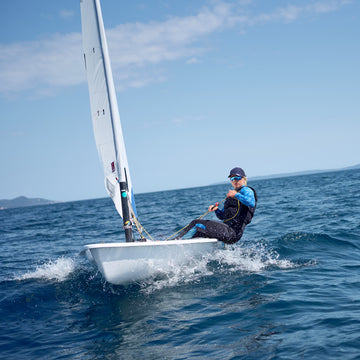
Some smaller clubs reduce the amount of sailing that’s available over the winter months so it’s worth persuading your parents to put the boat on the roof rack so that you can take advantage of some of the great training opportunities that exist through Class Associations. Before moving into Lasers (4.7s & now just starting in a Radial), I sailed a Topper for 4 years and the International Topper Class Association (ITCA) offers a great programme of locally based training each winter. From first starting out to when competing at National Squad level I found that it really helped me to gain knowledge, not only from the coaches, but through meeting other sailors who sail the same type of boat and who can share tips and advice on which events to attend and how to progress. Aside from that it was also great fun! Here are some links that detail what’s available across some of the Junior classes:RS TeraCadet
TopperRS FevaLaser 4.7 (or ILCA4)
Some smaller sailors can find it off-putting when the weather turns colder but if you’ve got the right clothing then sailing can be just as enjoyable whatever the weather. In my first season I was less than 40kg and was advised to wear a dry-suit. This was fine once I’d realised that it’s what you wear underneath and not the suit itself, that keeps you warm. As soon as I started doing events that involved staying on the water for longer, a wetsuit layering system became a much more practical option and something that I found I much preferred. Rooster do a great range of kit for sailors of all sizes and in a previous blog I talked in more detail about what I’ve found works best for me. You can read this HERE
After training over the winter I love the feeling that you get when you start to compete again and can put into practice what you’ve learned. It’s as if you’re taking off a blindfold as you find out where you are in the rankings again. When you’ve tried club racing a good next step is to enter open events on your local traveller circuit, these generally start in the spring and details will be published on your Class Association website. In my experience these events tend to be really friendly and welcoming and if you’ve done winter training through the Class Association they’re a great way to meet up again with the friends that you’ve made from other clubs. There's some RYA support in getting involved with higher level training HEREI started on the pathway to national sailing more or less by accident (and partly due to my mum’s bad geography) and I’m hoping that by sharing these tips it may be easier for others to make the most of what’s on offer. I think the best advice that I can give is:- Don’t be afraid to enter events and try things that are new - remember that most sailors are happy to share experiences and give advice, so do just ask! - Don’t be put off if things don’t work out as planned straight away, enjoy your sailing and if you’re going to be winter training in a Laser Radial this year I’ll see you on the water, come and say "Hi!"
Nick Welbourn :-)
"Pocket-Rocket" Set Up Tricks: RS Aerocup
After unknowingly being given the nickname ‘Pocket-Rocket’, published on both the main event web page and in Yachts and Yachting, which I only found out about the day before the event, I now had to live up to the prestigious title and Malcesine, Garda was the perfect place to do so.
The first day of racing was forecast for light winds with a 1300hr start, which was spot on. There was about 5-9knots on the race course from the south with about 20 degrees of heat – perfect! I went out, not sure what the day would bring, but was pretty relaxed either way as the back drop of the mountains was enough to make it a good day to be on the water. In no time at all, the first race was underway and I surprised myself with a 1st place with a considerable lead. Two more bullets in the next two races left me coming off the water in a good place. I think that reading Sam Whaley’s recent blog after the UK nationals on sailing in light winds helped my upwind speed considerably, where I applied the following:
Minimal kicker. Only take up a bit of the slack when the main sheet is pulled in (end of boom in line with aft outer corner). As the wind slightly increased, the kicker can be tweaked an inch or two to compensate
Cunningham and outhaul relatively loose
Play the mainsheet as the main setting – let out in lighter patches, and pull in a bit in the gusts to promote an extra squeeze in height
Point 5-10 degrees lower to increase VMG
Taking this into the second day, I fired out another 1st place in the first race. With the second race came more wind seeing gusts of approx 14/15knots, where I found myself having to considerably de-power, being the smallest in the fleet - "Pocket" sized.
With this increased wind, the last race was to go either way. Luckily the wind decreased and shifted back to the right on the first beat (as it did when the wind decreased on the previous day), where I spotted it early and sneakily tacked on the incoming shift, coming in to the windward mark with a considerable lead on the rest of the fleet, who over stood the layline. Throughout the rest of the race, I was able to extend my lead to finish over a leg ahead of the rest of the fleet. I had to live up to the ‘Pocket Rocket’ name somehow!
Going into the third day with all race wins, it was then a challenge (set in the bar) to try to finish the regatta with a straight set of wins, which I knew would be difficult in the stronger forecast morning winds. The first race was at 8.30am!! Once on the water, I was ready for a day of max hiking and max de-powering to maintain my position. The fight was definitely more difficult with much closer racing, only getting one race by half a boat length on the finish line, but I managed to achieve my goal – somehow!! Walking was a bit of a challenge when I came off the water! What made me quick for a lightweight was:
Cunningham – pull on as hard as possible
Kicker – pull on as hard as possible, this helps the sail to spill air out the top of the leach when the mainsheet is let out. It’s amazing how much effect pulling on the cunningham and kicker has on the top leach area of the sail if you look up
Outhaul – still relatively loose to power through the waves. Because I had de-powered the sail so much everywhere else, I needed some shape to it in order to move.
Play the mainsheet a lot to keep the boat flat/constant heel
Hike until your quads feel like they might potentially tear!
So my first win in the Aero is complete in true Pocket Rocket form! Makes a difference to my usual style of losing it on the last day/race. Also, no OCS’s or black flags - another personal record!
The event was organised brilliantly at Fraglia Vela Malcesine, and Peter Barton, once again, didn’t fail to disappoint with his enthusiasm and hard work throughout the event. It also wouldn’t be the same without the great bunch of sailors both on and off the water. Got to thank my dad for driving all the way with my boat as well - cheers Dad!
Looking forward to the next one!
Kate Sargent

How To Keep Warm When Training Through The Winter
First Published by Nick Welbourn - October 2016.
As the sailing season draws to a close many people will be packing up their boats for the winter and forgetting all about sailing for a while. But if you're one of those oddballs who’s getting ready to sail straight on through the winter, whether it’s for your club’s winter series or for squad training, like me, you’re going to need to make sure that you're prepared for whatever the lovely British weather may throw at you.
I remember, three years ago, aged 11, when I was first selected for the Topper North Zone Squad I spent most of the winter simply trying to stay warm. At this time of year many young sailors across the country who have just been selected for zone squads etc. may be about to face the same dilemma so, 3 years on I thought I’d share what works for me.
I began my first winter in a dry suit. It was OK to start with, I could just about stay warm and get through the day when training inland, but with a dry suit the warmth comes from what you wear underneath it and I really didn’t enjoy being bulked up like the Michelin man. Also, as soon as I started sailing on the sea, which sometimes meant being out on the water for up to 6 hours at a time, a dry suit just wasn’t practical.
I then spent a long time trying to find kit that would keep me warm through winter, not restrict movement and not bankrupt my parents. That was when I discovered Rooster and, after trying various options, I have finally got there. I’ve got kit that keeps me warm in all weathers and I can concentrate on sailing and improving rather than just thinking about how cold my hands are!
I think there are a few important things when trying to get the right kit to keep warm:
1 - Base Layers . A common mistake that you see people making in winter to try and keep warm is layering rash vest over rash vest. I tried it when I started sailing - it doesn’t work! The theory behind this is explained by Steve in this video. Once I’d realised this mistake and switched to Polypro it made a huge difference. They work really well as they wick the moisture away from your skin. For the autumn, and even on cooler summer days, I wear a Polypro Top under my sailing wetsuit and as the temperature drops I add Polypro Socks, Leggings and other layers.
Photo Courtesy of Simon McIlwaine - www.wavelengthimage.com
Rooster Topper Worlds 2016.
2 - Mid Layers Then comes the most important layer - the wetsuit. Rooster seem to have got this right with the Supertherm Longjohn and Top. My Supertherm Longjohn is probably my favourite Rooster product. By swapping and changing other layers I’ve worn it all year round, layered up in winter or just with a polypro top underneath on cool summer days. I can also fit my Rooster Hiking pads inside the long john.
3 - Extremities To keep my feet warm under my sailing boots in winter I wear a pair of Supertherm Wet Socks over my Polypro socks, just to add an extra layer of warmth, as it is very easy for hands and feet to get cold.
What to wear on my hands has always been a tricky one for me as I find that I need both a lot of grip and also a lot of warmth; a tricky combination to find. I have tried normal sailing gloves and thermal builders’ gloves and loads of other types of gloves, but now I think I have finally found the right solution for me. I wear Rooster AquaPro gloves, which are really good because the fleece lining keeps your hands warm. They also keep your hands mostly dry and with the fancy PU coated Amara grip on them I am certainly not short on grip. I also usually wear a pair of Rooster Hot Hands which are basically a Hot Top for your hands! And recently I have been trying Rooster’s Polypro glove liners.
Photo Courtesy of Simon McIlwaine - www.wavelengthimage.com
Rooster Topper Worlds 2016.
4 - Top Layer On top of all this it is important to have a good spray top to beat the wind-chill. In winter I wear a Rooster Pro Aquafleece. I find that this is a great product because, as well as having wind chill protection, it also has a lovely fleece inside to add even more warmth and the adjustable seals at the waist and wrists prevent cold water flushing when you hit a wave. Along with this I wear an Pro Aquafleece Beanie as it doesn’t absorb as much water as a usual knitted hat would if you happen to be unfortunate enough to fall in!
I find that if you wear the right kit it makes sailing in the winter so much more productive and most of all enjoyable. Each time someone else retires from a race because they’re cold, if you’re still out there you’re assured of finishing one place further up the fleet!
Nick Welbourn
Gear Guides
Need help finding best kit for you? we got you covered.
Product Support Hub
Videos and instructions to give you tips and tricks.
Garment Care
The right care helps your gear perform at its best and go the distance.
The Blog
Discover tips, tricks and stories from the Rooster team and guest writers.
Revive
Need repairs? Our trusted local partner has you covered.
Custom Clothing
Custom performance clothing for clubs, events, and organisations.
- Choosing a selection results in a full page refresh.
Select Store
EU
US